

You’ve probably heard the word “astigmatism” at some point, maybe at an eye exam, maybe from a friend. It often sounds a bit confusing at first. But what does it actually mean for your vision?
Astigmatism is a common vision condition where the cornea or lens has an irregular shape, which prevents light from focusing clearly on the retina. It’s not a disease. It doesn’t mean something is wrong with your eye health in a serious way. It simply means your eye focuses light a little differently than a perfectly round eye would, and A comprehensive eye exam is usually all it takes to find out where you stand.
How Your Eye Shape Affects Vision
Most eyes are round and even all the way around, much like a basketball. An eye with astigmatism is shaped more like a football, longer in one direction than the other.
That subtle difference in shape changes how light lands on the back of your eye. Instead of focusing on one sharp point, light spreads across multiple points. Things look blurry or slightly distorted as a result, whether you’re reading a menu close up or checking a road sign down the street.
Signs You Might Have Astigmatism
Astigmatism doesn’t always feel dramatic. Some people live with mild astigmatism for years without realizing it. But your eyes often give you clues.
Common signs include:
- Blurry or distorted vision at near and far distances
- Frequent headaches, especially after reading or screen time
- Eye discomfort or a tired, strained feeling
- Squinting to bring things into focus
If any of these sound familiar, it’s worth getting your eyes checked. These symptoms can also come from other vision conditions, and often only an eye exam can tell you what’s actually going on. Astigmatism can occur alongside other conditions like nearsightedness or farsightedness, which is another reason a full exam matters.
Astigmatism in Children
Kids rarely tell you their vision is blurry because they don’t know it should look any different. Blurry is just normal to them. Uncorrected astigmatism in children often looks like difficulty reading, trouble focusing in class, or sitting too close to the television.
It easily affects learning without anyone suspecting a vision problem. Book routine eye exams for your children from an early age. Uncovering these issues early gives kids the visual support they need for school.
What Causes Astigmatism
Astigmatism is most often inherited. If one or both of your parents have it, there’s a good chance you might too. It can also develop after an eye injury or certain eye surgeries. In some cases, ongoing pressure from rubbing your eyes may contribute to how the eye shape develops over time.
Clearing Up Common Myths
Reading in dim light doesn’t cause astigmatism. Neither does staring at a screen for hours. These habits can make your eyes feel tired and strained, but they don’t change the shape of your cornea. If screen time leaves your eyes feeling worn out, it’s more likely due to digital eye strain than to astigmatism itself. Astigmatism comes from your eye’s physical structure, not from how you use your eyes day-to-day.

How an Optometrist Diagnoses Astigmatism
The good news is that astigmatism is straightforward to detect. It shows up during a routine comprehensive eye exam, the same kind you’d book for a regular vision check.
Your optometrist uses a few specific tools to check your eyes:
- An eye chart to assess how clearly you see at different distances
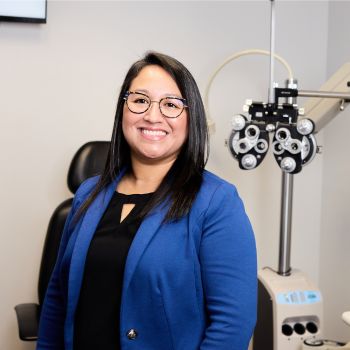
- A phoropter to test different lens combinations and find what brings things into focus
- An autorefractor to get an initial reading of how your eye bends light
- Corneal measurements to map the shape and curve of your cornea
Reading Your Eye Prescription
If you have astigmatism, you’ll see 2 specific numbers on your prescription. The cylinder number tells you the degree of astigmatism. The axis number tells you where on the cornea it’s located, measured in degrees from 1 to 180.
A cylinder value of 1.5 diopters or more usually means corrective lenses will improve your vision noticeably. Your optometrist will explain your numbers and discuss your available options.
Correction Options for Astigmatism
Glasses are the most straightforward option. Lenses made for astigmatism are shaped to compensate for the uneven curve of your cornea, so light focuses properly when it reaches the back of your eye. You can choose from a variety of frames and lens types, including single-vision and progressive options.
Contact lenses are also an option, though not every type may work for you. Toric soft lenses are designed specifically for astigmatism and stay in place on your eye to correct vision accurately. Rigid gas-permeable lenses can also work well, as they hold their shape on the eye and create a smooth surface for light to pass through.
For those interested in a longer-term option, laser surgery can reshape the cornea to improve how it focuses light. Ask your optometrist if you’re a good candidate during your next visit.
Does Astigmatism Change Over Time?
Yes, astigmatism can change as you age. As your eyes grow during childhood and adolescence, astigmatism can grow with you. That’s why getting regular eye exams helps keep your prescription accurate. A lens that worked 2 years ago might not be giving you the clearest vision today.
Next Steps for Seeing Clearly
Understanding your vision helps you make informed choices for your eye health. Our team takes the time to check your vision thoroughly and explain your results in plain language. Book an appointment with Cochrane Eyecare and take a simple step toward seeing more clearly. Reach out today to schedule your visit.